

14 Sep 2026
Gas Thermostats: Mechanical vs. Electronic Control


While reviewing information on commercial gas-fired equipment, we came across Robertshaw's 275 Series Electric Gas Thermostat Note 1 : when the thermostat calls for heat, it energizes a silicon carbide igniter. Once the igniter reaches the required operating condition, the gas valve opens. By comparison, traditional gas thermostats such as the BJWA, FD, and GS series still use mechanical control methods such as bypass control, modulating control, and snap-action operation. Looking at these two approaches side by side helps illustrate an important point: as gas-fired equipment moves from mechanical to electrical and electronic control, the real change is not simply the knob or the appearance, but rather "who senses the temperature, who makes the control decision, and who regulates the gas."
Think of a Thermostat as a "Temperature Manager"
For those who are new to commercial gas-fired equipment, a Thermostat Note 2 can be thought of as the equipment's "temperature manager."
Traditional mechanical gas thermostats typically integrate temperature sensing and gas regulation within the same mechanical control architecture. A sensing bulb and capillary tube respond to temperature changes, and the internal mechanism then adjusts the gas supply accordingly.
Some designs use Snap-action Note 3 control, which quickly switches the gas supply on or off when the temperature reaches the set point. Others use Modulating Note 4 control, which gradually adjusts gas flow as the temperature approaches the desired setting. A Bypass Note 5 function can also be used to maintain a preset low-flame condition. These traditional control methods can still be found in Robertshaw's BJWA, FD, and other thermostat series.
The value of this type of architecture goes beyond cost. Because the control path is relatively direct, the relationship between components is also easier to understand. For equipment with relatively simple functions, long operating hours, or applications where fast and straightforward field servicing is especially important, mechanical designs can still offer significant practical value.
Taking Alpha Brass Controls products as an example, the AG Mechanical Thermostat uses snap-action ON/OFF control, while the ABJ Mechanical Thermostat incorporates bypass adjustment. These represent two different approaches to mechanical temperature control.
With Electronic Control, What Changes Is "How the Work Is Divided"
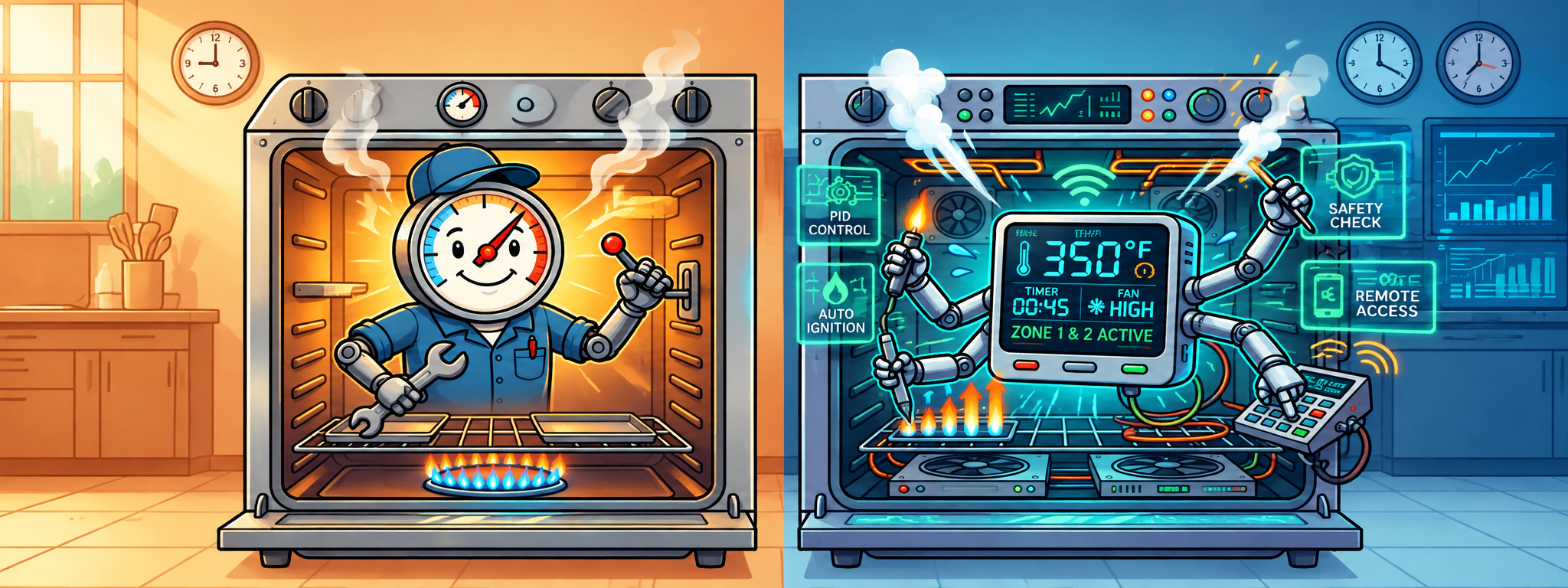
When electrical or electronic control is introduced, the biggest difference is that functions previously concentrated within a single component can begin to be distributed among multiple components.
Using the Robertshaw 275 Series as an example, the thermostat not only senses temperature but also participates in the ignition sequence through its electrical contacts, energizing a Silicon Carbide Igniter Note 6 and then working together with the gas valve to initiate combustion.
There is, however, one point that can easily cause confusion: an Electric Gas Thermostat is not necessarily the same as what we commonly refer to today as a fully electronic or digital controller. It is better understood as one type of architecture that combines mechanical temperature sensing with electrical control.
As equipment becomes more automated, temperature sensing, ignition, gas regulation, blower operation, and safety monitoring may all be handled by different components. This makes it easier to incorporate Diagnostics Note 7 , staged heating, and even more precise combustion control. On the other hand, servicing such equipment may require technicians to evaluate sensors, control modules, igniters, gas valves, wiring, and signal paths individually.
So, Is Electronic Control Always Better?
There is no single answer.
If an application prioritizes structural simplicity, intuitive servicing, and a mature and proven control method, a mechanical thermostat may still be an excellent choice.
On the other hand, if the equipment requires automatic ignition, finer flame modulation, operating-status monitoring, or integration with the overall equipment control system, an electronic control architecture can provide greater design flexibility.
Alpha Brass Controls also offers products that reflect both approaches. In addition to mechanical thermostats such as the AG and ABJ series, more integrated combustion-control solutions can incorporate the APV01 Proportional Gas Valve Note 8 together with the AE0201 Control Module, ignition components, and blower systems to provide more precise control of gas flow and combustion output.
Therefore, rather than viewing "mechanical vs. electronic control" simply as new technology replacing old technology, it may be more useful to evaluate each approach in terms of cost, control accuracy, reliability, serviceability, and the actual requirements of the equipment.
The most suitable control method for the equipment is ultimately what matters most.
Technical Term Notes
1. Electric Gas Thermostat
In addition to temperature control, this type of thermostat incorporates electrical contacts that can participate in the control sequence for components such as an igniter or gas valve. It should not automatically be considered equivalent to a fully electronic or digital controller.
2. Thermostat
A device that senses equipment temperature and controls heating or cooling according to a set point, helping maintain the temperature within a specified operating range.
3. Snap-action
A control mechanism that rapidly switches between ON and OFF states when the temperature reaches or approaches the set point.
4. Modulating
A control method that does not simply switch fully ON or OFF, but instead progressively adjusts gas flow or heat output in response to temperature changes.
5. Bypass
A gas-flow arrangement used in some gas thermostats that allows a preset minimum gas flow to be maintained even after the main valve has reduced the burner output.
6. Silicon Carbide Igniter
A type of hot-surface igniter that uses electrical current to heat a silicon carbide element to a sufficiently high temperature to ignite the gas.
7. Diagnostics
Functions that use operating-status signals, fault codes, or control logic to help identify abnormalities in sensing, ignition, or control components.
8. Proportional Gas Valve
A gas valve that adjusts gas flow according to a control signal. Compared with simple ON/OFF control, it provides greater flexibility for regulating combustion output.
References
1. Robertshaw – 275 Series Electric Gas Thermostats
2. Robertshaw – Gas Thermostats / OEM Solutions
3. Alpha Brass Controls – AG Mechanical Thermostat
4. Alpha Brass Controls – ABJ Mechanical Thermostat
5. Alpha Brass Controls – APV01 Proportional Gas Valve
6. Alpha Brass Controls – Combi Oven Solution
#GasThermostat #TemperatureControl #GasControl #GasValve #CombustionControl #CommercialCooking #CommercialKitchen #CommercialFoodservice #MechanicalThermostat #ElectronicControl #AlphaBrassControls