


A 180°C setting does not mean every spot is 180°C
Take a gas griddle as an example. From the temperature setting to the moment heat actually reaches the food, the process generally follows this path:
The thermostat senses the temperature at a specific location and adjusts the heating condition through the gas control system. However, once heat leaves the burner, it must still pass through the griddle or cookware before it finally reaches the food.
Therefore, “the control point being close to the set temperature” and “the entire cooking surface maintaining the same temperature” are actually two different things.
The ASTM F1275 test method for commercial griddle performance also evaluates thermostat accuracy separately from temperature uniformity across the cooking surface. In other words:
Control Accuracy Note 3 ≠ Temperature Uniformity Note 4
How do cookware and griddles affect heat?
After heat enters the metal from the burner, several common factors can affect how it is distributed.
The first is Thermal Conductivity Note 5. Different materials transfer heat outward at different rates, so when one area receives stronger heating, the speed at which heat spreads to surrounding areas can also differ.
Another factor is thickness. A thicker pan base or griddle plate generally provides more material through which heat can spread laterally, but it may also change preheating time and temperature response.
Another important factor is Thermal Mass Note 6. When a large quantity of refrigerated food is placed on a griddle at once, the surface temperature drops. A cooking surface with greater thermal mass is generally less likely to experience a rapid temperature drop over a short period.
In addition, the flatness of the pan base or griddle, actual contact area, flame coverage, burner arrangement, and the location of the temperature-sensing element can all affect the final temperature distribution.
Previous heat-transfer studies on multilayer metal cookware bases have also shown that material and construction can affect surface temperature distribution after heating. Therefore, cooking performance should not be judged simply by whether cookware is expensive or inexpensive. A more useful question is whether the cookware matches the equipment's heat source, construction, and actual cooking method.
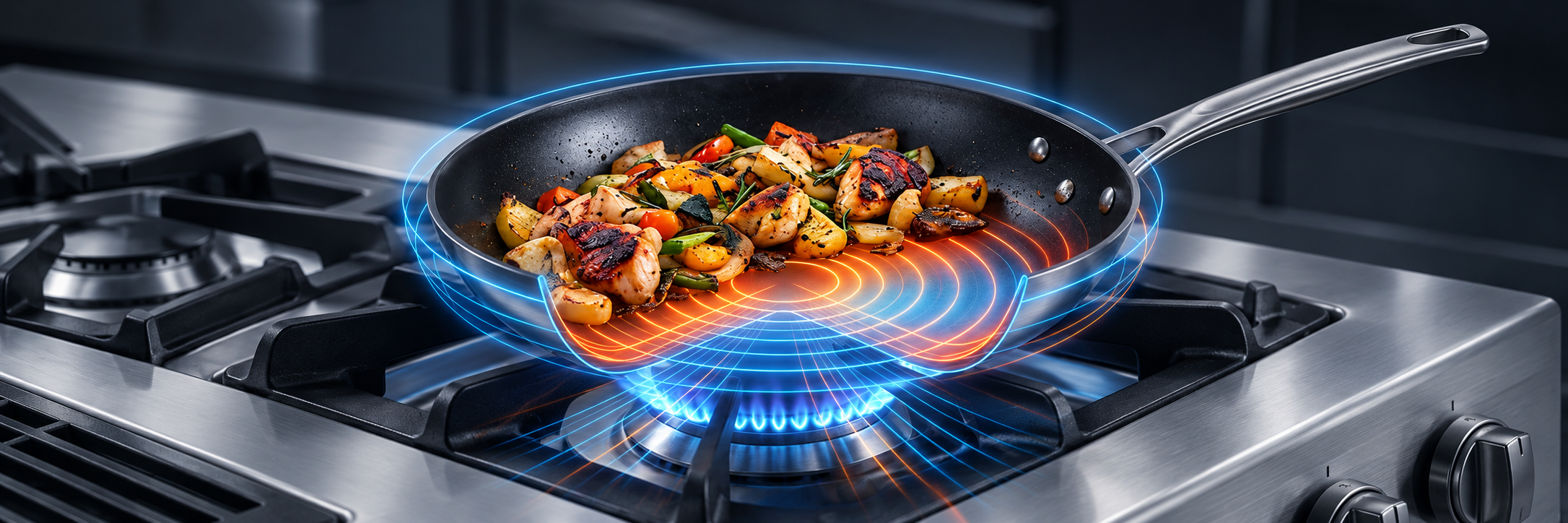
Uneven heating does not always mean a faulty thermostat
If a griddle shows a pattern such as “the left side burns easily while the right side cooks more slowly,” it is natural to suspect the thermostat first.
For a more complete diagnosis, however, it is useful to check not only whether the thermostat's sensing point is accurate, but also the actual temperatures at different areas of the griddle, gas pressure, flame condition, burner arrangement, the condition of the griddle or cookware, and the actual cooking load.
ENERGY STAR materials on commercial griddles also note that improving cooking-surface temperature uniformity can involve not only better thermostat control, but also factors such as high-thermal-conductivity griddle materials and temperature-sensor placement.
In other words, an accurate thermostat is important, but it controls only one part of the overall system.
From component accuracy to equipment stability
For commercial kitchen equipment designers, the ideal result is not simply that “one component is highly accurate,” but that temperature sensing, gas control, combustion, heat transfer, and actual cooking load work together effectively.
Alpha Brass Controls has long developed thermostats, gas valves, and related combustion-control components, all of which play important roles in the temperature-control chain. From the perspective of the complete appliance, however, component-level control performance still needs to work together with the proper burner, griddle plate, cookware, and temperature-sensing arrangement before it can translate into stable cooking performance.
So the next time the set temperature appears normal but food still heats unevenly, it may not be necessary to immediately assume that a specific component has failed.
Sometimes, what deserves a closer look is the entire heat-transfer and control chain.
Technical Notes
A device that senses temperature through a sensing element and controls the heating system according to the set temperature. In commercial gas equipment, it can work together with a gas valve to control burner operation. Back to text
A component used to control gas opening, shutoff, or flow. Depending on the equipment design, it can work together with thermostats, ignition systems, and other safety-control components. Back to text
The degree of deviation between the actual controlled temperature and the target setting. Higher control accuracy means the control point can remain closer to the set temperature. Back to text
The temperature variation between different locations on a cooking surface at the same time. Even if the control-point temperature is accurate, other areas of the cooking surface may still have temperature differences. Back to text
A material's ability to conduct heat. Different metals have different thermal-conductivity characteristics, affecting how quickly heat spreads through structures such as cookware bases and griddle plates. Back to text
An object's ability to store thermal energy and resist rapid temperature changes, related to factors such as material mass and specific heat. In cooking equipment, thermal mass affects temperature drop and recovery after cold food is placed on the cooking surface. Back to text
References
https://www.foodserviceequipmentjournal.com/signature-fse-and-falcon-launch-de-buyer-cookware-trial-kits/
https://store.astm.org/f1275-14r20.html
https://www.energystar.gov/products/commercial_griddles
https://www.sciencedirect.com/science/article/pii/S0306261904000947
#CommercialKitchenEquipment #CommercialGriddle #Thermostat #GasValve #TemperatureControl #HeatTransfer #CookingPerformance