


The Same Symptom Can Have Different Causes
Take a commercial griddle as an example. If a user reports, “It is set to 180°C, but the temperature still will not rise,” the thermostat Note 1 is often the first component suspected. However, if the inlet gas pressure Note 2 is too low, the burner may not receive enough gas to deliver the required heat input. The result can be the same: slower preheating and longer temperature recovery.
Therefore, a “temperature problem” does not always have a single cause. For equipment manufacturers, service technicians, and R&D teams, it helps to examine the issue from three different perspectives.
Component Failure Note 3 means that a component can no longer perform its intended function even under correct operating and installation conditions.
For example, a thermostat may switch at a significantly incorrect temperature, its sensing mechanism may malfunction, or a gas valve may fail to open, close, or control gas flow as designed.
In such cases, independent component testing, calibration checks, or failure analysis may be appropriate.
Application Failure Note 4 can easily be mistaken for a quality issue.
For example, if an equipment redesign changes the griddle plate thickness, burner input, sensing probe location, or heating structure, the overall temperature response may change even when the same thermostat is used. In other words, “the component meets its specification” does not necessarily mean “it will perform identically in different equipment.”
A component still needs to be evaluated together with the equipment's thermal load, sensing location, and control method. Mechanical thermostats from Alpha Brass Controls, for example, are available with different temperature ranges, sensing probes, and capillary tube configurations according to equipment requirements. Component selection is therefore part of the overall equipment design.
Installation Failure Note 5 originates from conditions outside the equipment itself.
An unsuitable gas pipe size, insufficient gas supply capacity, incorrect voltage, or installing highly electronic equipment in an area with excessive heat or heavy grease exposure can all prevent the equipment from operating properly.
For gas-fired equipment, a practical troubleshooting sequence is:
Checking these conditions step by step before deciding whether to replace a component often makes it easier to identify the actual root cause.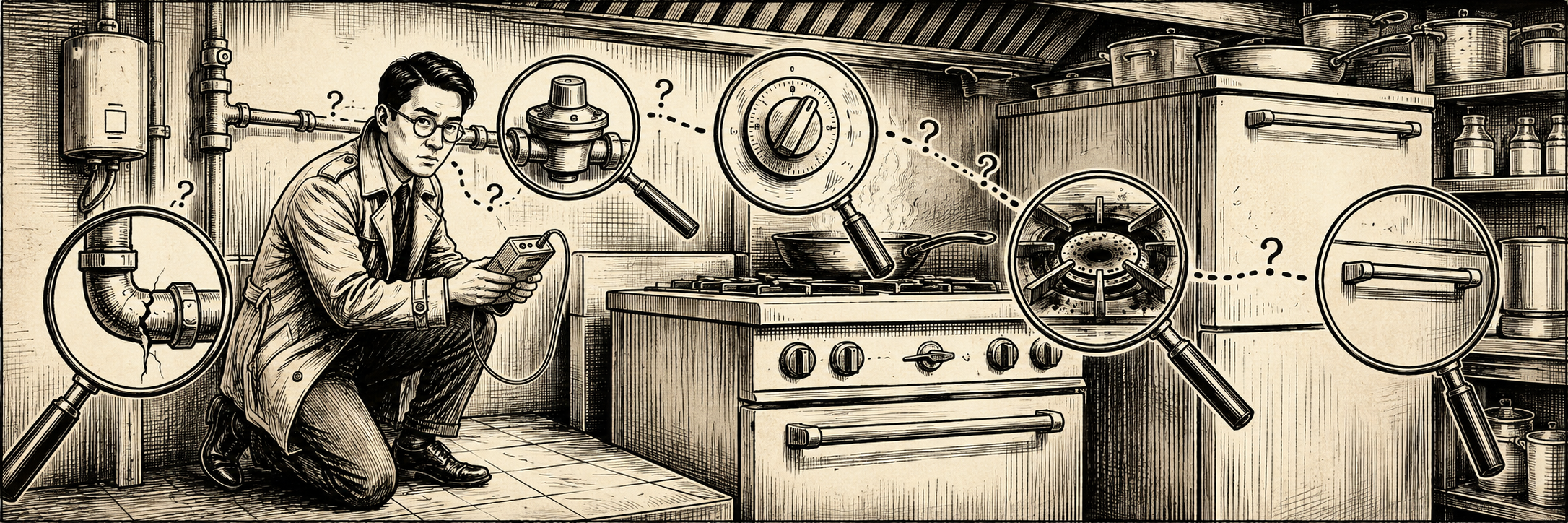
Commercial cooking equipment is an interconnected system.
Gas valves, mechanical and electronic thermostats, and related combustion-control components from Alpha Brass Controls are each part of that system. The thermostat's temperature range and sensing probe configuration, as well as the gas valve's operating pressure and flow conditions, must all match the actual equipment design.
So when equipment behaves abnormally, instead of immediately asking, “Which component has failed?”, it may be more useful to first ask: “Are the component's current operating conditions the same as those it was designed for?”
Troubleshooting from the component, application, and installation levels can reduce unnecessary component replacement and help QA, R&D, and service teams identify the real cause more quickly.
References
https://fesmag.com/topics/trends/23860-how-to-avoid-warranty-woes
https://files.middleby.com/usermanuals/Blodgett_900_DeckOven_Manual_1.pdf
https://www.middleby.com/learn/commercial-kitchen-maintenance-tips/
#CommercialKitchen #GasEquipment #GasValve #Thermostat #TemperatureControl #EquipmentMaintenance #FailureAnalysis #Troubleshooting #AlphaBrass