

19 Oct 2026
Why Commercial Kitchens Shouldn’t Wait for Failure


Still running does not mean everything is normal
A common situation in commercial kitchens is that an oven still heats, a fryer still ignites, and cooking equipment continues to operate. As a result, even when small abnormalities appear, the usual response may be to “keep using it for now.” Yet equipment may already be showing warning signs before an actual failure occurs.
For example, the same 180°C setting may suddenly require a longer heating time; equipment that previously ignited on the first attempt may occasionally need another try; or the unit may begin cycling on and off more frequently, or even experience a High-Limit EventNote 1.
These signs do not necessarily mean that a particular component has already failed. They may simply indicate that the equipment is no longer operating quite the way it used to.
This is why commercial kitchen maintenance is gradually evolving from Reactive MaintenanceNote 2 toward Preventive MaintenanceNote 3, Condition MonitoringNote 4, and even Predictive MaintenanceNote 5.
Simply put, the goal is moving from “repair it after it fails” toward “detect changes before a real shutdown occurs.”
Has the temperature started to feel different?
For heating equipment such as ovens and fryers, Thermostat CalibrationNote 6 is a typical example.
A thermostat controls the heat source according to changes in equipment temperature. After long-term operation, however, the set temperature and actual temperature may gradually drift apart. The equipment may still cook food, but kitchen staff may begin noticing that “it seems to take a few more minutes than before.”
Commercial equipment service procedures therefore often include actual temperature measurements to confirm whether the set point and measured temperature remain within an acceptable range. Hobart’s service documentation for commercial gas ovens, for example, includes temperature measurement and calibration procedures.
This illustrates an important maintenance principle: we do not necessarily need to wait until equipment “stops heating completely” before paying attention to temperature-control components.
It still ignites, but is ignition becoming unstable?
Another easily overlooked signal is Ignition ReliabilityNote 7.
Suppose a piece of equipment used to ignite normally every day, but recently it sometimes fails on the first attempt and works again after being restarted. Many users may not consider this significant. From a maintenance perspective, however, a change in ignition success rate is information worth recording.
Ignition abnormalities in commercial gas equipment may involve the pilot, ignition system, gas supply, gas valve, safety controls, or contaminated orifices. A single symptom therefore cannot be used to immediately identify one failed component.
What matters is noticing whether equipment behavior that was once stable is gradually changing.
Grease is more than a cleaning issue
Grease, steam, and cooking residues are unavoidable in commercial kitchens, so cleaning is not only a food-hygiene issue.
If grease and contamination gradually accumulate around the pilot assembly, burner orifices, or sensing areas, they may also affect combustion and control performance. Service documentation for some commercial gas appliances includes blocked Pilot OrificesNote 8, temperature-control components, high-limit devices, and gas valves among the items to inspect when troubleshooting abnormal operation.
Regular cleaning therefore does more than make equipment look clean. It also helps combustion, sensing, and control systems remain within their intended operating conditions.
Valve cycles can also reveal equipment usage
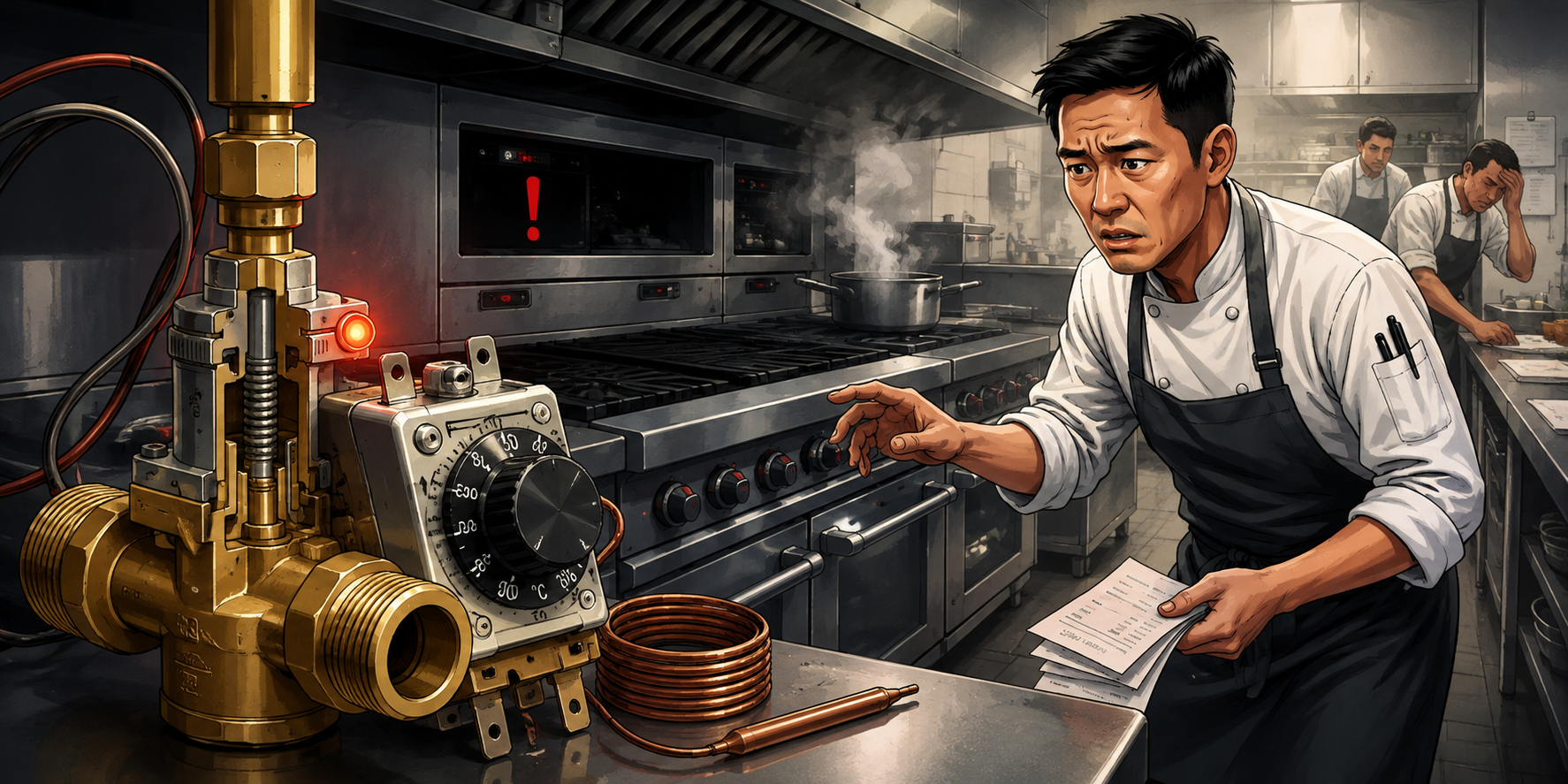
When an oven or fryer maintains its set temperature, the gas-control system repeatedly opens and closes according to heating demand. Valve Cycle CountNote 9 can therefore be viewed as one indicator of equipment usage intensity.
This does not mean that a gas valve must be replaced after reaching one fixed number of cycles. Actual service life still depends on product design, operating environment, gas conditions, and the equipment’s control strategy.
However, if equipment previously had a regular heating cycle and suddenly begins switching on and off much more frequently, it may be worth checking whether temperature sensing, control logic, usage conditions, or another part of the system has changed.
A safety trip is also an important record
A High-Limit ThermostatNote 10 is an important safety-control component in many commercial heating appliances.
When equipment reaches an abnormal temperature, the high-limit device may interrupt the heating or gas-control circuit. The important question is not only “how do we restart it?” but also “why did it trip this time?”
If equipment had rarely experienced over-temperature protection in the past but begins triggering it repeatedly, the unit should be inspected according to the equipment manufacturer’s service procedures rather than simply being reset again and again.
Maintenance is really about managing change
Predictive Maintenance does not necessarily have to begin with AI, big data, or an entire Connected KitchenNote 11.
A practical starting point may simply be recording whether temperature remains accurate, ignition remains stable, equipment cycling behavior changes, when cleaning was performed, and whether a high-limit event has occurred.
As these records accumulate, the question changes from “Which component failed?” to “What is different about this equipment compared with before?”
In commercial kitchen equipment, gas valves, thermostats, ignition modules, and high-limit controls may only be individual parts of a larger system, but together they participate in gas supply, temperature control, ignition, and safety protection.
This is also an important consideration in Alpha Brass Controls’ long-term development of gas-control and temperature-control components: the value of a component is not only whether it can be replaced after a failure, but whether it can continue providing stable and reliable control through repeated daily operation.
When maintenance evolves from “repairing equipment” to “managing equipment condition,” what commercial kitchens are really managing is the small day-to-day changes in their equipment.
Technical Terminology
1. High-Limit Event | Over-Temperature Protection Event
An event in which equipment reaches an abnormal temperature and the high-limit safety device activates. The cause should be checked according to the equipment manufacturer’s instructions.
2. Reactive Maintenance | Failure-Driven Maintenance
A maintenance approach in which inspection, repair, or component replacement begins only after an abnormal condition or failure occurs.
3. Preventive Maintenance | Preventive Maintenance
Planned cleaning, inspection, calibration, and component maintenance based on time, usage, or a predefined schedule.
4. Condition Monitoring | Condition Monitoring
Observing current equipment condition and trends through information such as temperature, pressure, ignition status, operating cycles, and abnormal-event records.
5. Predictive Maintenance | Predictive Maintenance
Using historical and current equipment data to identify abnormal trends and assess maintenance needs before a failure occurs.
6. Thermostat Calibration | Thermostat Calibration
Comparing the equipment set temperature with the actual measured temperature to confirm reasonable temperature-control accuracy, with adjustment performed according to manufacturer requirements when necessary.
7. Ignition Reliability | Ignition Reliability
The ability of equipment to complete the ignition process consistently and reliably under normal operating conditions.
8. Pilot Orifice | Pilot Orifice
A small opening used to control gas flow to the pilot flame. Grease, foreign material, or carbon buildup may cause abnormal pilot operation.
9. Valve Cycle Count | Valve Actuation Cycle Count
The number of valve opening and closing operations, which may serve as one reference for equipment usage frequency and operating condition.
10. High-Limit Thermostat | High-Limit Safety Thermostat
An important safety-control component used to interrupt or limit heating-system operation when equipment temperature exceeds its safe set range.
11. Connected Kitchen | Connected Kitchen
A kitchen environment in which equipment and management systems are network-connected so that operating status, maintenance information, and energy-use data can be centrally monitored and managed.
References
1. Foodservice Equipment Journal, “FEJ 2026 Buyers’ Guide now out,” 24 August 2026
https://www.foodserviceequipmentjournal.com/catering-insight-2026-buyers-guide-now-out/
https://www.foodserviceequipmentjournal.com/catering-insight-2026-buyers-guide-now-out/
2. Catering Insight, “Catering Insight 2026 Buyers’ Guide now out,” 24 August 2026
https://www.cateringinsight.com/catering-insight-2026-buyers-guide-now-out/
3. Hobart, SG Series Gas Convection Ovens — Service Procedures and Adjustments
https://www.hobartcorp.com/sites/default/files/webdam-assets/SG%20Series%20Ovens%20Customer%20Maintenance%20Manual%20%2802-21%29.pdf
#CommercialKitchen #KitchenEquipment #EquipmentMaintenance #PreventiveMaintenance #PredictiveMaintenance #GasValve #Thermostat #IgnitionSystem #TemperatureControl #FoodserviceEquipment