

08 Oct 2026
Why Are Commercial Kitchen Equipment Controls Becoming More Standardized?


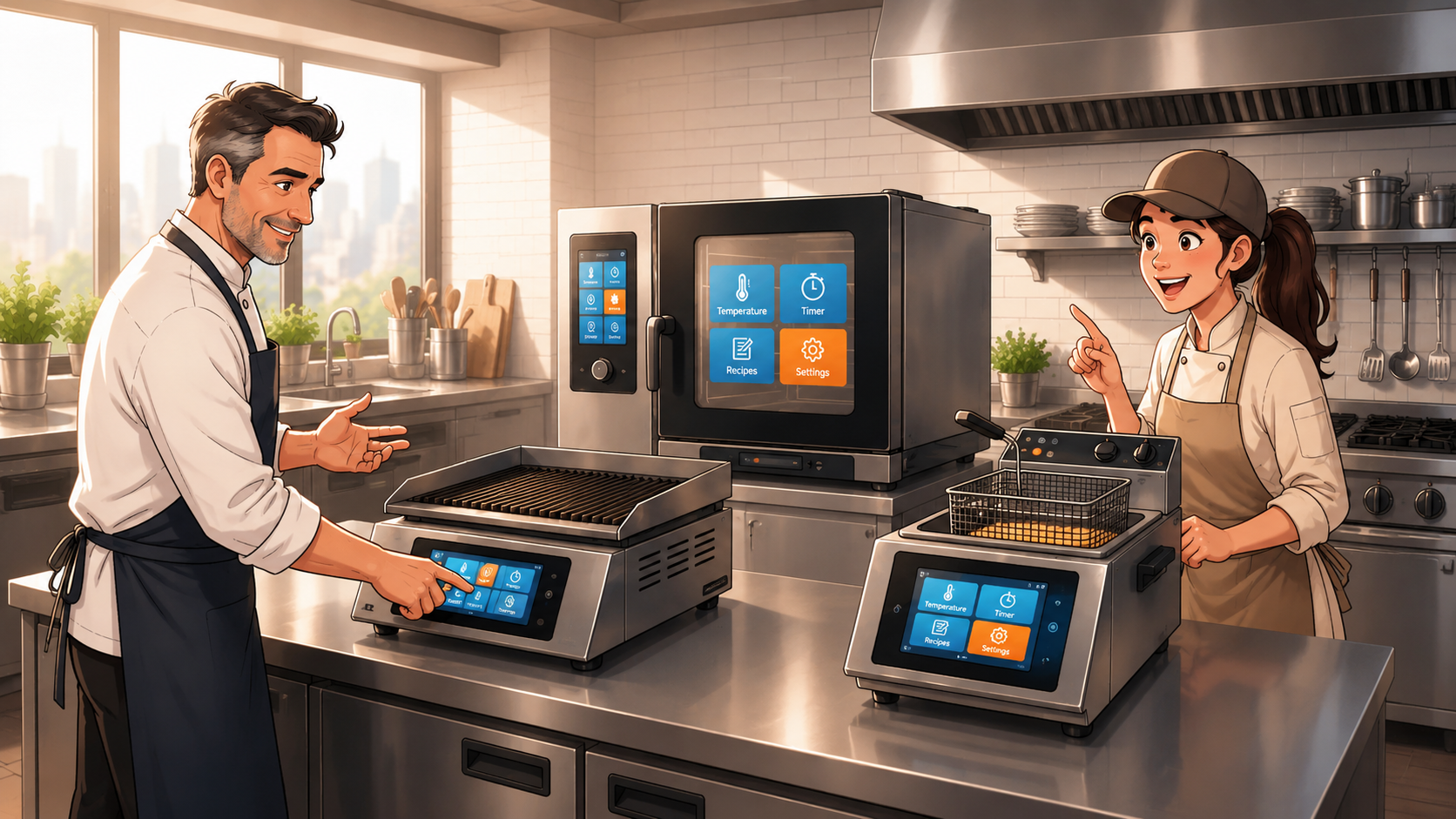
In July 2026, commercial foodservice equipment manufacturer Middleby introduced the latest developments of its OneTouch control interface, designed to provide a more consistent touchscreen operating experience across different types of equipment, including High-Speed Ovens, Conveyor Ovens, and Grills. In addition to a unified interface, the system also incorporates Programmable RecipesNote 1, cooking progress displays, and other functions. Middleby also cites its own research indicating that, with a shared operating interface, the average time required to complete certain functions can be reduced by approximately 22 seconds. This figure is based on the manufacturer's own system and should not be generalized to all commercial kitchens. Nevertheless, the broader trend toward standardized equipment operation is worth a closer look.
Middleby: Touchscreen Commercial Kitchen Equipment
Different Equipment, Different Operating Methods?
A commercial kitchen may use ovens, fryers, griddles, and combi ovens at the same time. For an experienced chef, differences between equipment controls may not be a major issue. For newly hired staff, however, moving from one machine to another can mean learning a completely new set of buttons, icons, settings, and cooking procedures.
This is why some equipment manufacturers are beginning to ask: even if different machines perform different functions, do they really need completely different operating logic?
The concept behind Middleby OneTouch is to provide similar interfaces and control methods across different categories of equipment. Once operators become familiar with one machine, they do not necessarily need to start from scratch when using another. This approach is not simply about creating a more attractive display; it is also closely related to training time and day-to-day operating efficiency. In previous introductions of OneTouch, Middleby has also linked consistent control interfaces with reduced training requirements and improved cooking consistency.
From “Remembering Settings” to “Selecting a Recipe”
Another important change is that cooking procedures are increasingly being programmed directly into the equipment.
With Programmable Recipes, operators can predefine cooking time, temperature, and parameters for different cooking stages. Staff may only need to select the desired menu item, after which the equipment follows the predefined cooking program.
This is particularly important for chain restaurants. Their goal is not simply to cook food thoroughly, but also to maintain similar cooking results across different locations, shifts, and operators.
In other words, equipment is gradually evolving from simply being a “machine that provides heat” into part of a standardized cooking process.
Standardization Is Also Moving Toward Central Management
When a restaurant expands from a single location to dozens of sites, another question arises: when a new menu is introduced, does every location need someone to manually reconfigure each piece of equipment? This is one reason why Central ManagementNote 2 is receiving increasing attention.
Middleby's Open Kitchen platform currently supports connected-equipment monitoring, recipe creation and remote deployment, real-time temperature data, alerts, predictive analytics, and other functions. For operators managing multiple locations, the object being managed is therefore no longer just a single oven, but potentially an entire group of machines distributed across different sites.
When equipment is connected through the IoT (Internet of Things)Note 3, this information can also become a useful basis for equipment management.
Diagnostics May Become Increasingly Important
As equipment becomes increasingly digital, DiagnosticsNote 4 will also become an important part of the smart commercial kitchen, alongside the operating interface itself.
Information such as whether equipment is operating normally, whether temperatures are abnormal, whether alerts have been triggered, and even which machines may require maintenance can potentially be presented through a centralized connected system.
This means that “standardization” is not only about making equipment easier for frontline staff to operate. It can also make it easier for managers and service technicians to understand equipment status.
A Simpler Screen Does Not Mean Simpler Control
From the perspective of gas and temperature control, areas familiar to Alpha Brass Controls, there is another interesting aspect of this trend.
On the screen, operators may see only a few simple steps such as “select recipe,” “set temperature,” and “start cooking.” Inside the equipment, however, the system may still need to perform temperature sensing, ignition, gas supply control, heat-output modulation, and over-temperature protection.
Depending on the equipment architecture, the system may incorporate thermostats, gas valves, ignition and control modules, or a Proportional Gas ValveNote 5 to provide more precise gas-flow modulation.
Therefore, a simpler front-end interface does not mean that the equipment itself has become simpler. On the contrary, as cooking programs become increasingly automated, reliable coordination between the operating interface and the underlying temperature-control, combustion, and safety systems becomes even more important.
What Becomes Standardized May Be How We Use the Equipment
Ovens, fryers, and griddles in commercial kitchens will continue to have different functions and structures, but the way people operate them may become increasingly similar.
From consistent touchscreen interfaces and programmable recipes to central management and equipment diagnostics, the underlying trend is clear: commercial kitchens are transforming more “experience and operating procedures” into “logic that equipment can execute and manage.”
For the equipment industry, the key point may not simply be how sophisticated the touchscreen looks. What matters is whether the temperature-control, gas-control, and safety systems inside the equipment can reliably and accurately execute a simple command once it is entered.
Technical Term Notes
1. Programmable Recipes | Pre-Programmed Cooking Recipes
Cooking time, temperature, stages, and other related parameters can be stored in the equipment in advance. Once the operator selects a specific cooking program, the equipment executes the predefined settings automatically.
2. Central Management | Centralized Equipment Management
Data from different pieces of equipment or different locations is consolidated into a single management system, making it easier to monitor equipment, manage parameters, and update content.
3. Internet of Things (IoT) | Connected Equipment Network
IoT allows equipment to transmit and exchange data over a network, enabling remote monitoring, data analysis, and centralized management.
4. Diagnostics | Equipment Diagnostics
Equipment operating data, alerts, and fault information are used to help operators and service technicians understand equipment condition and identify possible causes of abnormal operation.
5. Proportional Gas Valve | Modulating Gas Control Valve
A gas-control component that regulates gas flow in response to a control signal. Compared with simple on/off gas control, it can be applied in systems that require continuous modulation of combustion output.
References
2. Middleby — There’s Power in One Touch
An introduction to the shared OneTouch interface, cooking consistency, and operating efficiency.
3. Middleby — IoT Kitchen Solutions
An introduction to Open Kitchen's equipment monitoring, remote recipe deployment, alerts, and data-analysis capabilities.
#CommercialKitchen #CommercialKitchenEquipment #SmartKitchen #KitchenAutomation #FoodserviceEquipment #TemperatureControl #GasControl #CookingAutomation #AlphaBrassControls