

01 Oct 2026
Oven at 180°C—Is the Chicken 180°C Too?


A recent discussion on Reddit r/Cooking asked: “How do you bake chicken breasts without ending up with dry, rubbery meat?” Many responses pointed to the use of a food thermometer. This everyday cooking question highlights an important concept: the oven set temperature is not the same as the food’s core temperature.
Suppose an oven is set to 180°C. This 180°C is first of all the equipment’s setpointNote 1. The temperature control system regulates the heat source based on the temperature sensed by the equipment, helping maintain the required heating environment inside the oven. However, the actual oven temperature can still be affected by factors such as door opening, load size, airflow, and equipment design.
Once food is placed in the oven, heat is transferred (Heat Transfer Note 2 ) from the oven environment to the surface of the chicken and then gradually moves toward its interior. The process can be understood simply as:
Set Temperature → Oven Temperature → Heat Transfer to Food Surface → Food Core Temperature
These four stages are related, but they do not represent the same temperature.
This is also why the same instruction—“Bake at 180°C for 20 minutes”—can produce different results depending on the size, thickness, or initial temperature of the chicken breast. USDA FSIS recommends using a food thermometer to verify the internal temperature of poultry. The minimum safe internal temperature (Core Temperature Note 3 ) is 165°F / 73.9°C.
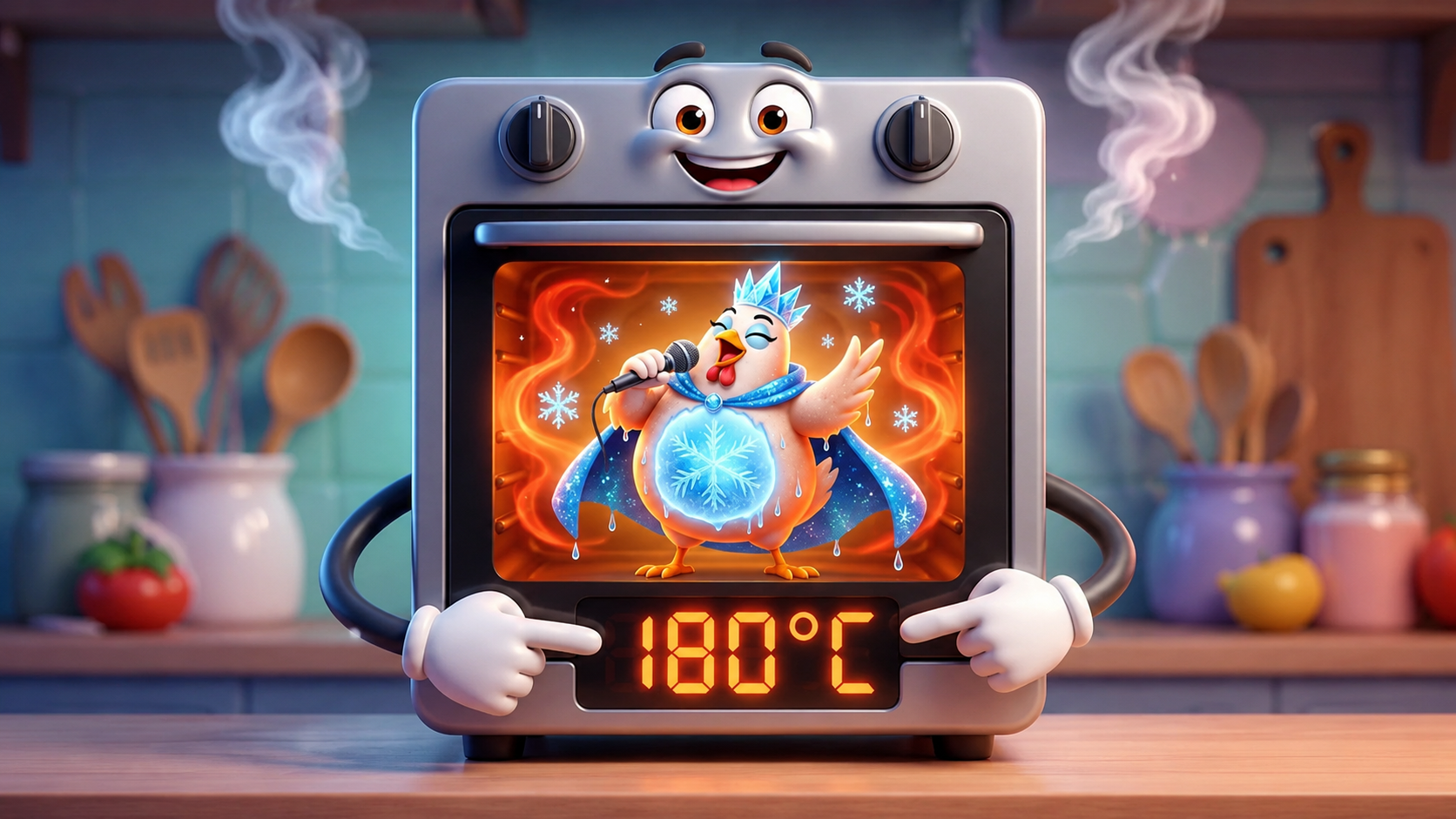
From an equipment perspective, the role of a thermostat is to help establish and maintain the required thermal environment inside the equipment. For the gas temperature control products and solutions developed by Alpha Brass Controls Inc., the objective is likewise to enable gas-fired equipment to regulate temperature according to its intended design, rather than directly determining the final core temperature of the food. In other words, more stable equipment temperature control does not necessarily mean that a chicken breast will always be more tender. The final cooking result is still influenced by cooking time, food size, moisture content, heat transfer method, and equipment characteristics.
So, the next time a recipe says “Set the oven to 180°C,” it may be worth thinking one step further: 180°C refers to the oven—but what temperature has the center of the food actually reached?
Technical Term Notes
1. Setpoint | Target Temperature Setting
The target temperature specified by the control system. It does not mean that every location inside the equipment will remain exactly at that temperature at all times.
2. Heat Transfer
The process by which heat moves from a higher-temperature region to a lower-temperature region. In cooking, this commonly involves conduction, convection, and radiation.
3. Core Temperature | Internal Food Temperature
The actual temperature measured inside the thicker or slower-heating portion of a food product. It is an important reference for determining whether food has reached a safe cooking temperature.
References
1. Reddit r/Cooking, What is the actual secret to baking chicken breasts…
2. USDA FSIS, Safe Minimum Internal Temperature Chart
3. USDA FSIS, Food Thermometers
#Oven #CoreTemperature #FoodSafety #Thermostat #TemperatureControl #HeatTransfer #CommercialKitchen #GasControl #AlphaBrassControls