

07 Sep 2026
EN 13203-1 Update: How Is Water Heater Performance Evaluated?


On July 23, 2026, the Official Journal of the European Union published Commission Implementing Decision (EU) 2026/1717, which included the updated EN 13203-1:2025 Note 1 among the harmonised standards Note 2 referenced for gas-fired water heaters. The standard focuses primarily on the assessment of hot water delivery performance for gas-fired domestic appliances and supports EU requirements related to ecodesign and energy labelling for water heaters. For equipment manufacturers, the significance goes beyond the addition of another standard. It also highlights how gas input, temperature control, ignition, and other functions work together to create measurable and verifiable overall appliance performance.
What Does the Updated Standard Focus On?
The key point of EN 13203-1:2025 can be understood quite simply:
How well does a gas-fired water heater actually perform when delivering hot water?
This EU decision supports Regulation (EU) No 814/2013 and Delegated Regulation (EU) No 812/2013. The former addresses ecodesign requirements for water heaters and hot water storage tanks, while the latter covers energy labelling and product information.
Therefore, the focus of the assessment is not on examining an individual gas valve or controller in isolation, but on evaluating the performance of the complete appliance during operation.
This also gives us another way to think about water-heating equipment: its overall performance is actually the result of many control components working together.
From Opening the Tap to Stable Hot Water
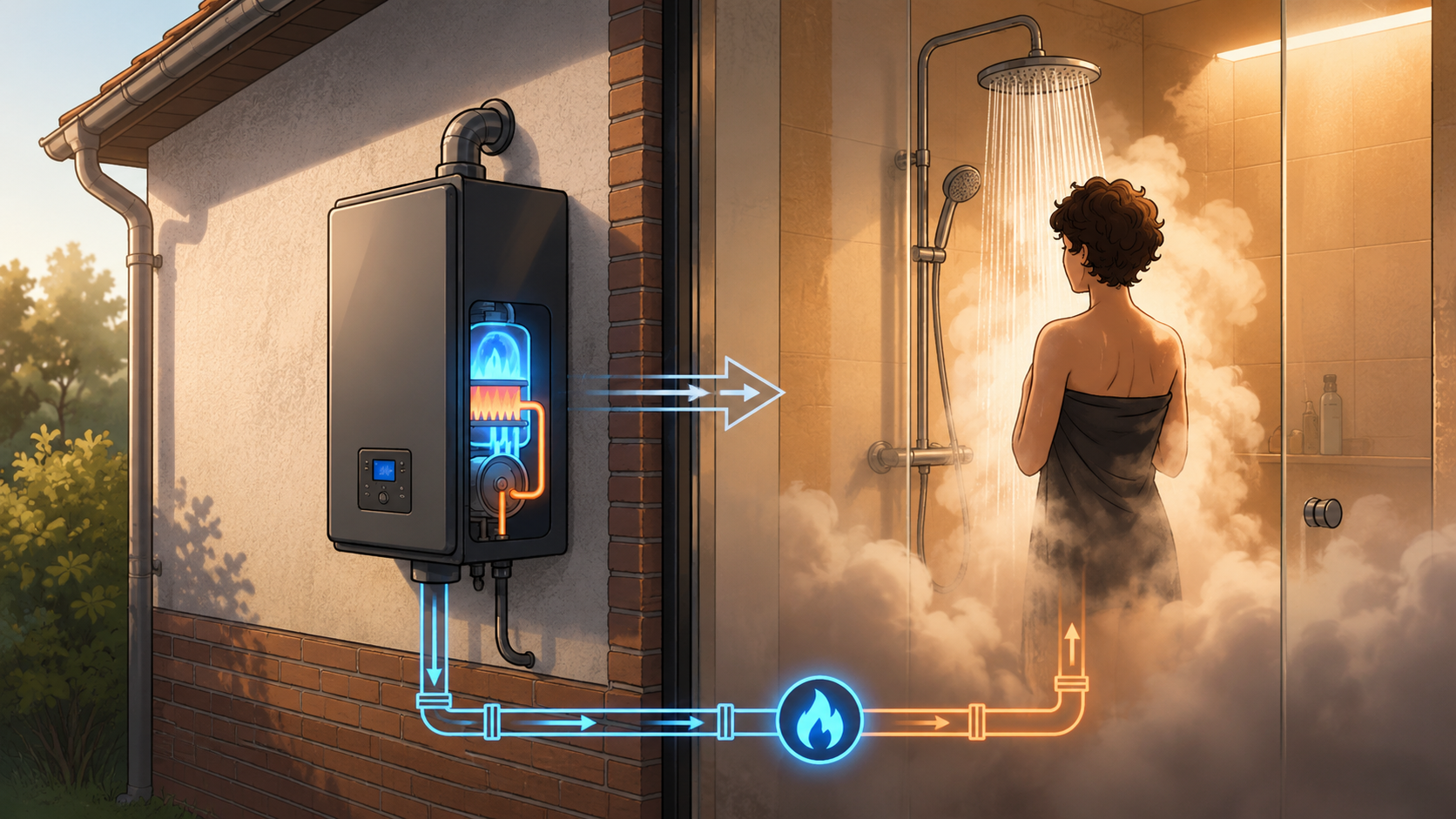
Turning on a hot-water tap may seem like a simple action, but inside the appliance, a sequence of control functions has already begun.
Once the system detects a demand for hot water, it must initiate ignition, supply gas, establish a flame, and then adjust the heat input according to water flow and temperature.
This is where several types of control components commonly used by Alpha Brass Controls each play a different role.
Gas valves control the opening and regulation of the gas supply. If the appliance needs to vary burner output according to operating load, proportional gas valves can help regulate gas flow accordingly.
Meanwhile, thermostats and temperature control components respond to changes in temperature. When the inlet-water temperature, flow rate, or user demand changes, the system needs to adjust heat input appropriately in order to keep the water temperature within the intended range.
Before heating can actually begin, there is another important stage—— ignition control . From the ignition sequence and gas supply to flame verification, each step must be completed according to the control logic designed for the appliance.
For this reason, hot water performance is not determined simply by whether the burner provides enough heat. It is the combined result of gas control, temperature regulation, ignition, and the overall control system.
Good Component Performance Does Not Automatically Mean Appliance Compliance
This is also one of the most common misunderstandings when reading about the updated standard.
If a water heater uses stable and well-performing gas valves, proportional valves, or ignition modules, these components can certainly help the appliance establish a stable control system.
However, using a component that meets a particular specification does not, by itself, mean that the complete water heater complies with EN 13203-1:2025.
The “presumption of conformity” Note 3 provided through harmonised standards applies only to the regulatory requirements and conformity-assessment scope covered by the relevant standard.
Final appliance performance is also influenced by the burner, heat exchanger, water circuit, sensors, control software, and overall system design.
Looking Beyond Component Selection to System Performance
For manufacturers, this standards update offers a practical reminder:
When selecting control components, beyond asking “Will it fit?” and “Is the flow capacity sufficient?”, it may also be useful to consider a few additional questions:
Is the gas output stable?
Does the system respond appropriately to temperature changes?
Can consistent control be maintained under different operating loads?
Can the component be integrated effectively into the overall system?
As regulations and the market place greater emphasis on measurable and repeatable appliance performance, individual components are only the starting point. What ultimately matters is whether those components can work together to keep the complete appliance operating reliably and consistently.
This is also one of the broader considerations that we believe is worth taking away from EN 13203-1:2025.
Technical Notes
1. EN 13203-1:2025
A European standard titled “Gas fired domestic appliances producing hot water – Part 1: Assessment of performance of hot water deliveries.” It is primarily used to assess the hot water delivery performance of gas-fired domestic appliances.
2. Harmonised Standard
A standard developed by a European standardisation organisation and referenced in the Official Journal of the European Union. When manufacturers apply the relevant harmonised standard for conformity assessment, they may benefit from a presumption of conformity for the regulatory requirements covered by that standard.
3. Presumption of Conformity
In simple terms, applying a harmonised standard referenced by the EU can provide an important basis for demonstrating conformity with specific regulatory requirements. It does not mean that a product automatically complies with every applicable EU requirement.
References
1. European Commission — Commission Implementing Decision (EU) 2026/1717 of 20 July 2026
Harmonised standards for gas water heaters
Ecodesign requirements for water heaters and hot water storage tanks
Energy labelling of water heaters, hot water storage tanks and packages of water heater and solar device
#EN13203 #GasWaterHeater #GasControl #GasValve #Thermostat #IgnitionControl #TemperatureControl #EnergyEfficiency #OEM #AlphaBrassControls